
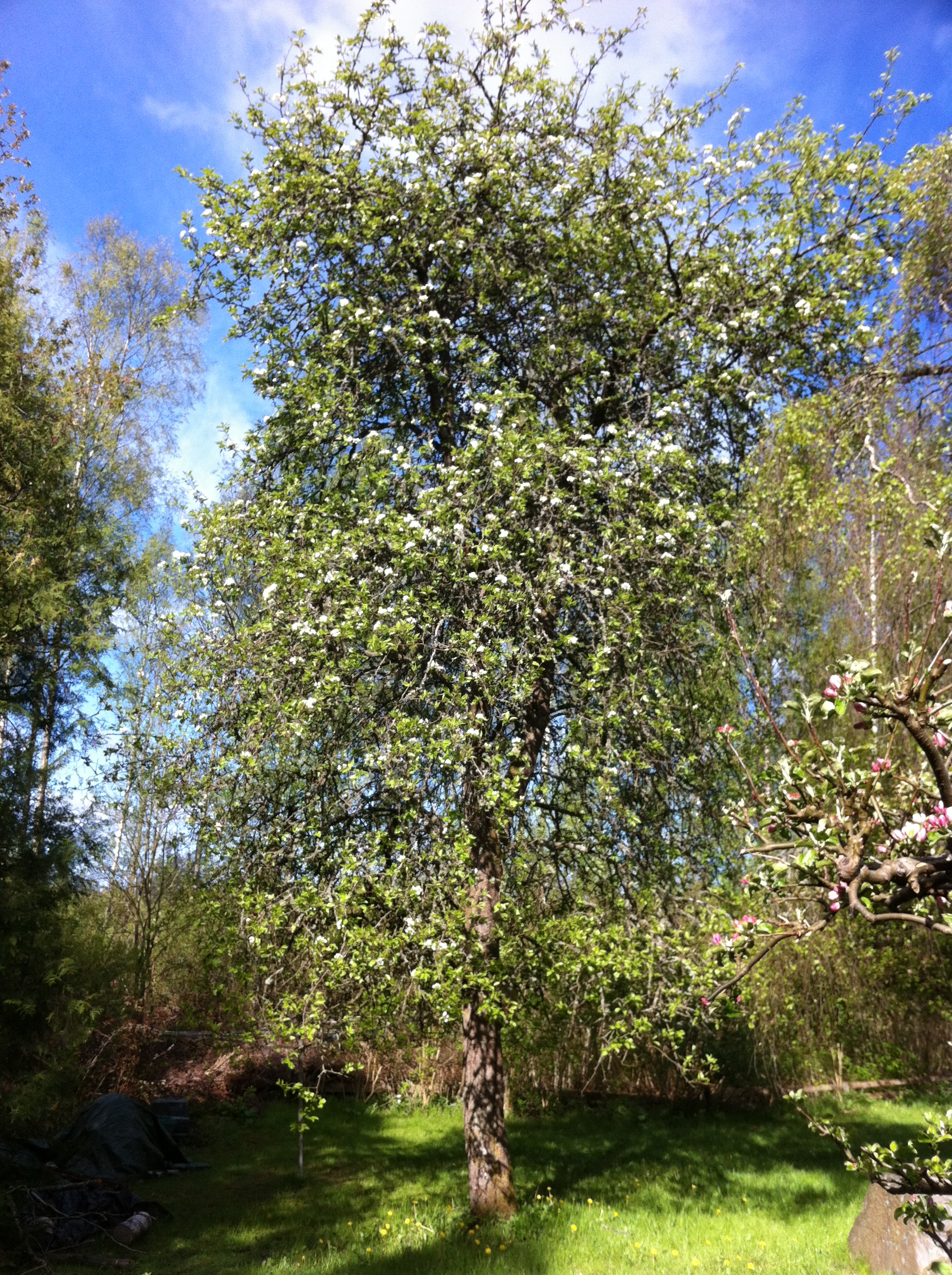
Pyrus Communis (pear tree) ‘Gris Bonne’
According to the Helmholtz-theorem a vectorfield is completely defined by the divergence and curl of the vectorfield.
the divergence is a measure of the strength of the source of the vectorfield whereas the degree of rotation of the field is given by the curl.
The divergence is defined as ∇·F = lim Δv→0 ∫A⋅ ds/Δv i.e. the scalarproduct(dotproduct) of the nabla operator and the vector.
The ∇-operator is defined as the vector differential operator
∇=∂/∂x + ∂/∂y + ∂/∂z.
When this operates on a scalar V one obtains the gradient ∇V of that scalar i.e. a vector that represents both the magnitude and the direction of the maximum space rate of increase of of that scalar.
The curl is defined by
∇xF. = (dFz/dy – dFy/dz) i + (dFx/dz – dFz/dx)j + (dFy/dx – dFx/dy) k
The electromagnetic field is defined by the divergence and curl of the Electric field vector E and the magnetic field vector B:
∇· E= ρ
∇xE=∂B/∂t
∇· B=0; This can be interpretated as stating the fact that there are no magnetic charges.
∇xB=∂D/∂t
These are the famous Maxwellian equations which gives a full description of the electromagnetic theory.
Every electromagnetic law can be deduced from them.


 Miniräknare/calculator
 Kristians Kunskapsbank


Pingback: Energi och Arbete | iMath