Integration by parts can be regarded as the inverse to the product rule for differentiation. Suppose U(X) and V(x) are two differentiable functions. According to the product rule
If the primitive function of an integrand can be found it is always best to take advantage of the fundamental theorem of calculus.
In order to be able to determine integrals whose indefinte integrals(primitive functions) cannot be found immediately some of the following motions can be useful:
variablesubstitution: This method can be developed by integrating the chain rule:
d/dx(f(g(x)) = f´(g(x)) g'(x) This gives:
∫f'(g(x))g'(x)dx = f((g(x)) + C
Then perform the substitution u = g(x). If we differentiate this we get du = g'(x) dx.
Substitution in the integral above yields the following:
∫ f(g(x)) g'(x) dx = ∫f ‘(u) du = f(u) + C
substituting back to g(x) and we have the answer: f((g(x)) + C.
Example: Determine ∫x/(x2+1)dx
This integral can be dealt with tby using the substitution
u = x2 + 1.
Then du = 2x dx → x dx = du/2.
Substitution transforms the integral to: ∫du/(2u) = ln|u| + C.
√Substituting back gives us the answer: 0,5·ln|x2 +1| + C = ln√(x2 + 1).
A good way of illustrating probabilities is to use so-called Venn-diagrams. In effect this means representing the probability of an event with circles.
Mutually excluding events can be represented by two separate non-overlapping ciecles.
P(A) + P(B) = P(A U B)
Simultanously events can be illustrated by partially overlapping circles. The overlap then represents the instance of both events happening simultanously.
A Diophantine equation is an equation in which only integers are allowed as coefficients. Also the solutions must be integers. This can be written as ax + by = c. This is a linear diophantine equation.
For non-linar diophantine equations there is no general solution formula available.
Ex. 8x + 7y = 148.
has the solutions x=1 and y = 20.
It can be showed that in order to give integer-solutions 148 must be divisible by the Greatest Common divisor of 8 and 7 in this case 1.
The probability of a certan outcome of an experiment can be calculated as the quotient of the number of outcomes giving the desired result and the number of possible outcomes.
P(A) = (number of outcomes giving the desired results)/ (number of all possible outcomes)
Therfore 0 < P(A) < 1 with 0 being the probability for an impossible outcome and 1 the probability for a certain outcome.
A multi-step experiment can be illustrated with a tree-diagram.
Two outcomes are complementary if either of them most occur if the other doesn’t.
The sum of their probabilities must be one. http://en.wikipedia.org/wiki/Probability_theory
Event Probability
A P(A)
not A CP(A) = 1- P(A) The complement to A
A or B P(A U B)= P(A) + P(B) for mutually exclusive events otherwise
P(A U B)= P(A) + P(B) – P(A ∩ B) The union of A and B i.e. the occurence of either of them.
A and B P(A ∩ B) The occutence of both of them at the same time can be found by multplying the individual probabilities: P(A)*P(B)*P(C)*…….. *P(Z).
A given B P(A¦B) =P(A ∩ B)/P(B) this gives the probability for A given that B has already happened.
Ekvationelösningens grunder visas i denna filmsnutt.
This is one of the most useful methods in mathematics when it comes to usefulness.
It means ‘the rule of three’ and concerns computing the third un-known variable when the two others are known.
An example from my Grandfather’s book ‘Textbook in Algebra for seminars’ written by J.Antonsson A.B. Magn. Bergvalls förlag 1924 Stockholm.
Ex. 388:
A person A builds a brick wall in 20 days. With aid of a co-worker B the wall is completed in only 12 days.
how many days would it take B alone to erect the wall?
Ans. Worker A builds 1/20 of a wall a day. This means that he completes 12/20 of the wall in 12 days.
Whence the other person must be responsible for 8/20 of the wall in 12 days.
therefore he completes 2/5/12 walls per day. This equals 1/30 wall per day.
So it takes 30 days for him to complete the wall.
Ekvationslösning
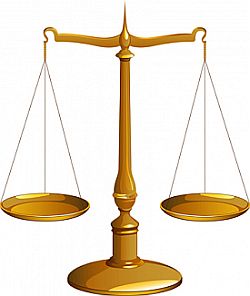
En bra analogi till en ekvation är en balansvåg.
En ekvation betyder en likhet och det är analogt med att vågen är balanserad så att den väger jämnt dvs så att det är lika mycket i de båda vågskålarna. Denna jämvikt kan bibehålles om man lägger på lika mycket i vänster som i höger vågskål. eller drar ifrån lika mycket i båda vågskålarna.
Faktum är att det är tillåtet att göra vad som helst i ekvationens ena led om man gör samma sak i det andra. Detta utnyttjar man vid ekvationslösning.
Exempel:
x + 2 = 5
Att lösa en ekvation innebär att man får x ensamt på ena sidan av likhetstecknet.
Det kan vi här få genom att man subtraherar med två på båda sidor om likhetstecknet.
x + 2 – 2 = 5 – 2
x = 3.
Man kan alltid kontrollera att ekvationen är korrekt löst genom att pröva lösningen dvs
man ersätter lösningen med det funna x-värdet.
Om lösningen är korrekt så blir då vänsterledet = högerledet.
Ett sätt att lösa ekvationer med nämnare är att förlänga båda leden med den minsta gemensamma nämnaren. Detta resulterar i att x avlägsnas från nämnaren och hamnar i täljaren istället. .
50/(3x) = 2/9
→
Mgn 9x
9x (50/(3x)) = 9x(2/9)
→
150 = 2x
→
x = 75
Olikheter hanteras på samma sätt som ekvationer. Den enda skillnaden är att man måste vända på olikhetstecknet om man förlänger eller förkortar med ett negativt tal.





 Miniräknare/calculator
 Kristians Kunskapsbank

