
The decimalsystem and some terminology

At this point it  might be wise to take a closer look at the decimalsystem which is the way we use to represent quatities in mathematics.

The decimalsystem is a positionsystem (based on powers of ten)  which means that the value of a  number is determined by its position in the number.

e.g. 333 = 3• 100 + 3• 10 + 3•1.

Thanks to this ingenous system it is possible to express all rational numbers   with just 10 digits (indo-arabian) 0 – 9. Equalling the number of fingers.

The natural numbers i.e. the positive integers are infinitely many.

This statement an be proved by adding 1 to any given candidate to being the biggest integer.

A peculiar fact is that the number of real-numbers (rational numbers + irrationalnumbers i.e. all the numbers between the real numbers) is higher than  the number of integers. But how can anyyhing be bigger than infinity?

Georg Cantor solved this problem by dividing infinity into different categories (Cardinalities): the natural numbers are countably infinite ℵ(Cardinal number)=0  wheras the real numbers are uncountably infinite ℵ=1.

The transcendental numbers however such as π and e cannot be be explicitly written with these integers and therefore one must use special signs for them.

A mathematical function is a rule that tells you how to caculate a value from a given variable. This value must be unambiguous: only one function value must correspond to a given variable value.

A continuous function is a function that can be drawn in a coordinate system without lifting the pencil from the paper.


Publicerat i matematik 1c, Uncategorized | Lämna en kommentar

Divergence and curl of vectorfields

PEar tree 'Gris Bonne'

Pyrus Communis (pear tree) ‘Gris Bonne’

According to the Helmholtz-theorem a vectorfield is completely defined by the divergence and  curl of the vectorfield.

the divergence is a measure of the strength of the source of the vectorfield whereas the degree of rotation of the field is given by the curl.

The divergence is defined as  ·F  = lim Δv→0 ∫A ds/Δv i.e. the scalarproduct(dotproduct) of the nabla operator and the vector.

The ∇-operator is defined as the vector differential operator
∇=∂/∂x + ∂/∂y + ∂/∂z.

When this operates on a scalar V one obtains the gradient  V of that scalar i.e. a vector that represents both the magnitude and the direction of the maximum space rate of increase of  of that scalar.

The curl is defined by

∇xF. = (dFz/dy – dFy/dz) i + (dFx/dz – dFz/dx)j + (dFy/dx – dFx/dy) k

The electromagnetic field is defined by the divergence and curl of the Electric field vector E and the magnetic field vector B:
∇· E= ρ

∇xE=∂B/∂t

∇· B=0; This can be interpretated as stating the fact that there are no magnetic charges.
∇xB=∂D/∂t

These are the famous Maxwellian equations which gives a full description of the electromagnetic theory.
Every electromagnetic law can be deduced from them.

Publicerat i Calculus, Uncategorized, Vectors | 1 kommentar

Vectorproducts

Vectors can be multiplied in two ways:

1. The scalar product gives product of a vector and the projection of  the other vector upon the first one. This is calculated according to

a b = ab cos(v)

The result is a scalar.  This statement can be proved with the following calculation:

Let C= A+B and form

C C = (A+B) (A+B) =

A2 + B2+2AB

Solving for AB =(C2-A2-B2/2

which is a scalar quantity since it is made up of absolute values.

An example is the amount of work, W, done by operating against a force F a distance x.

W=F ×cos(v)

where v is the angle between F and  displacement x.

2. As the vectorproduct

a x b = ab sin(v).

This gives the area of the parallellogram formed by vectors a and b. It can be shown (it follows directly by computing the vectorproduct of  (a1,a2,a3) and  (b1,b2,b3) and Sarrus rule) that the vectorproduct is another vector forming an orthogonal coordinatesystem with a and b.

Ex The Lorentzian force in physics is given by

F =q vxB. 

Here F equals the force on the particle with charge q moving with speed v through the magnetic field B.

Publicerat i Calculus, Uncategorized | Märkt , | 2 kommentarer

Numerical methods for calculation of integrals

For many functions it is impossible to find a primtive function and therefore it is impossible to use the fundamental theorem of calculus to solve the integral.

Luckily there are ways to cope with such circumstances with the aid of numerical methods. Here one has deviced a formula for approximation of the integral.

The perhaps the simplest one is the trapezoidal formula.

The principle is to divide the area into well-known entities( in this case trapezoids) for which the area may readily be computed.

A more refined method is thee.

 Simpson’s rule. This can be viewed as a combination of the midpoint-rule and the trapezoidrule. The midpoint rule basically amounts to approximating the area by rectangles. 

Publicerat i Calculus, matematik 5 | Märkt | Lämna en kommentar

Vector algebra-adding and subtacting vectors

Garden

The mass of your body is a measure of the amount of matter (atoms) that constitute your body. This number is a quantity that can be pinpointed on the x-axis (or any line of numbers). Such quantities are called scalars

It is important here to bear in mind the difference between weight and mass.

The weight is the pull of gravity acting upon any mass within the gravitational field.  This quantity not only has a size but also a direction. It is directed towards the center of gravity of the earth.

Galaxy M 83 15 million light-years away held together by gravity. Courtesy: Anglo-Australian telescope.

Such quantities possessing both mass and direction are termed vectors.

Many important physical quantities are not just quantities (As eg mass, energy and temperature) but  they also have a direction (as e.g. velocities, forces, momentum, pressure, accelerations).

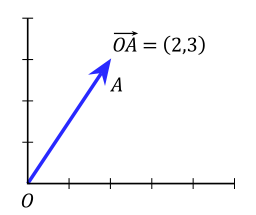
They are usually represented by the length and direction of an arrow or by the coordinates (x, y, z) of the endpoint of the arrow representing the vector beginning at the origin. They are often denoted by a bold letter (F) with an arrow above it.

Position vector

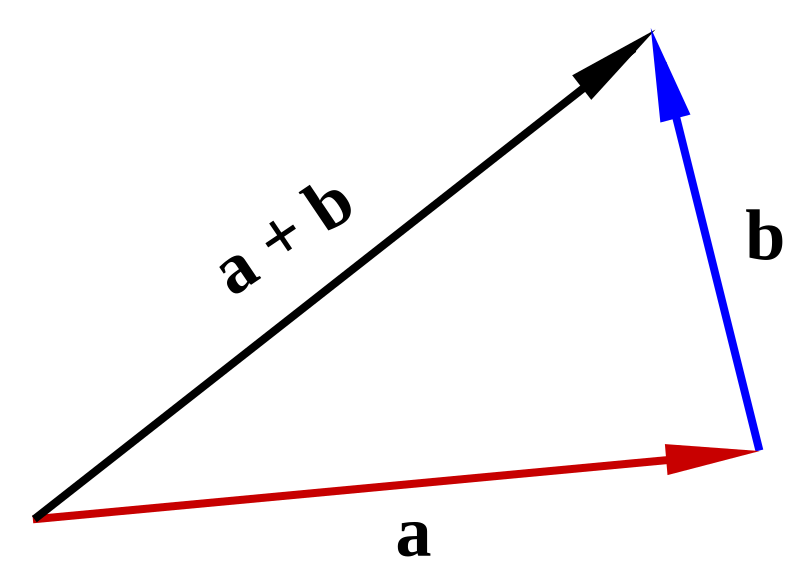
Vectors are added by the polygonal method which means that in order to obtain the vectorsum of several vectors you let the vector number two start at the endpoint of the first vector and so on. After you have drawn all the vectors like this after each other you are able to construct the vectorsum, or resultant, of all the vectors by drawing one vector from the startpoint of the first vector to the endpoint of the last vector.

File:Vectoraddition.svg

A vector can always be divided into x,y, and z-components

F=Fx i+ Fy j+ Fz k.

where i, j, k are the orthogonal unit vectors for the cartesian coordinatesystem.

This gives us the possibility to add vectors algebraically:

 F + G =  (Fx+Gx, Fy+Gy, Fz+Gz) i.e. add the x-coordinates separately and do likewise with the y and z-coordinates to acquire the coordinates of the sum.

Publicerat i Advanced | Märkt , | Lämna en kommentar

Symmetries, translations and dilatations

A good definition of symmetry was given by the mathematician Hermann Weyl: 
An object is symmetrical  if, after you performed an operation on it, it still looks the same as it did before.
  • A function can be moved in the horizontal direction so-called translation, by adding or subtracting a number. For example :

f(x) = sin(x-a) is the function f(x) = sin(x) moved a steps to the right.

  • The graph of a function can be moved in vertical direction (vertical translation) by adding or subtracing a number to the function e.g. f(x) = sin(x) +4 is the function f(x) = sin(x) moved four steps upwa
  •  A vectorial translation i.e. a translation in both the x- and the y- direction.  y= sin (x+a) +b.
  • By dilatation is meant a contraction or comprimation of the function. f(x) = sin(x/m) is an extraction of the function f(x)=sin(x/m) by the scale m.
  • A function may also be mirrored in the x-axis. -f(x) is the mirror -image of f(x) in the x-axis. f(x)=-sin(x) is the mirror-image of f(x) = sin(x) in the x-axis.
  • f(-x) is the mirror-image in the y-axis of f(x). f(x)=sin(-x) mirrors f(x) = sin(x) in the y-axis.
  • By combining both types of mirroring one obtains a mirroring in the origin of the function.
Publicerat i Calculus, Gymnasiematematik(high school math), Uncategorized | Lämna en kommentar

Properties of integrals

  1.  the integral of a linear combination is the linear combination of the integrals,
     \int_a^b (\alpha f + \beta g)(x) \, dx = \alpha \int_a^b f(x) \,dx + \beta \int_a^b g(x) \, dx. \,

If a > b then define

\int_a^b f(x) \, dx = - \int_b^a f(x) \, dx.

3.

Additivity of integration on intervals. If c is any element of [a, b], then \int_a^b f(x) \, dx = \int_a^c f(x) \, dx + \int_c^b f(x) \, dx.
4.
Upper and lower bounds. An integrable function f on [a, b], is necessarily bounded on that interval. Thus there are real numbers m and M so that mf (x) ≤ M for all x in [a, b]. Since the lower and upper sums of f over [a, b] are therefore bounded by, respectively, m(ba) and
M(ba), it follows that
      m(b - a) \leq \int_a^b f(x) \, dx \leq M(b - a).
 

20140507-183437.jpg

Applications in physics/technology of integrals.

Publicerat i Calculus, matematik 3c, matematik 4 | Märkt | Lämna en kommentar

Definite integrals

In a geometrical context the integral can be interpreted as the area between the graph of the integrand f(x) and the x-axis. The idea is to summarize infinitely many infinitely thin rectangles. (An alternative approach to areacomputation is the Lebesgue-integration where you partition the range of f(x)  instead of the domain). This method works better for integration of infinite series e.g. Fourier series than the Riemann integral.

The integral sign is a stylized version of the letter ‘s’.

Bernhard Riemann discovered that this can be accomplished by forming one ‘uppersum’ and one ‘lowersum’.

An undersum can be seen here and to see the oversum click here.

Riemann showed that there exists exacctly one number which is smaller than the uppersum and bigger than the lower sum in the limit when the width of the rectangles approaches zero.

This number is identical to the integral over this interval.

Earlier  in the 18th. century Newton and Leibniz discovered the fundamental theorem of calculus. This gives an easy method for computation of the integral with the aid of the primitive function

F'(x) =f(x)  then       F(x) = \int_a^x f(t)\, dt\,.

See the derivation of this theorem here in an excerpt from  the Gamma textbook (björup et. al.) Fundamentaltheorem.

F'(x) = (F(x+dx) -F(x))/dx   F’ (x) dx = (F(x+h) – F(x)).

By Summation of  all these differential areaelements   it can be seen that all terms cancel each other except the first and the last which gives us the fundamental theorem of calculus:

F(b) - F(a) = \int_a^b f(x)\,dx,


pp.175-180

Ex
=
∫x2dx = x3/3 = 33/3 -0 /3= 27/3 = 9.

Publicerat i Calculus, Gymnasiematematik(high school math), matematik 3c, matematik 4 | Märkt | 1 kommentar

Indefinite integrals

If you need to calculate the distance travelled when you know the velocity as a function of time , since s'(t) = v(t) you need to be able to perform antiderivation i.e. finding a function whose derivative equals your function.

This process is called integration.

Hence s(t) is the indefinite integral or primitive function, to v(t).

For an arbitrary function f(x) the primitive funktion is conventionally written as

F = \int f(x)\,dx. 
and  F’ (x) =  f(x). 
Table of indefinita integrals: 
formula                         
formula
formula
formula

formula

formula

formula

formula

formula

formula

formula

formula

formula

formula

formula

formula

formula

formula

formula

formula

formula

formula

Integrazione per sostituzione

Per il calcolo di integrali del tipo formula, talvolta può essere vantaggioso sostituire alla variabile d’integrazione x una funzione di un’altra variabile t, purché tale funzione sia derivabile e invertibile.

Ponendo formula, da cui deriva formula, si ha che:

formula di integrazione per sostituzione

Read moreIndefinite integrals – primitiva funktioner

p. 161-169

Publicerat i Calculus, Gymnasiematematik(high school math), matematik 3c, matematik 4 | Märkt , | Lämna en kommentar

Differentiating the natural logarithm, products and quotients

In order to be able to deduce the derivative of the natural logarithm we resort to using implicit differentiation.

Let x= ey(x)

Differentiating both sides gives

dx/dx = d ey(x)/dx

1=ey(x) dy(x)/dx

Solving for dy(x)/dx one obtains

dy(x)/dx = 1/ey(x) = 1/x .

The product rule is given by

d f(x) g(x)/dx = df(x)/dxg(x) + f(x) dg(x)/dx

A beautiful proof for this theorem is given by G.W. Leibniz:

(u + du) *(v+dv) = u*v + u*dv + v* du + du*dv.

The last term is the product of two infinitesimals and can therefore be neglected. The differential of the product of the two functions u(x)*v(x) is thus equal to

u(x)*dv + v(x)*du.

Q.E.D.

To read more about this formula click here.

The rule for differentiation of the quotient of  two functions can be deduced from the product rule and is given by

df(x)/g(x) =( df(x)/dx g(x) – f(x) dg(x))/dx)/(g(x))2.

Publicerat i Calculus, Gymnasiematematik(high school math), matematik 3c, matematik 4 | Märkt , , | Lämna en kommentar