Probability

The probability of a certan outcome of an experiment can be calculated as the quotient of the number of outcomes giving the desired result and the number of possible outcomes.

P(A) = (number of outcomes giving the desired results)/ (number of all  possible outcomes)
Therfore 0 < P(A) < 1 with 0 being the probability for an impossible outcome and 1 the probability for a certain outcome.
A multi-step experiment can be illustrated with a tree-diagram.
Two outcomes are complementary if either of them most occur if the other doesn’t.
The sum of their probabilities must be one.
http://en.wikipedia.org/wiki/Probability_theory

Event Probability
A                P(A)
not A        CP(A) = 1- P(A) The complement to A
A or B      P(A U B)= P(A) + P(B) for mutually exclusive events otherwise

P(A U B)= P(A) + P(B) – P(A ∩ B) The union of A and B i.e. the occurence of either of them.

A and B   P(A ∩ B) The occutence of both of them at the same time can be found by multplying the individual probabilities: P(A)*P(B)*P(C)*…….. *P(Z).
A given B P(A¦B) =P(A ∩ B)/P(B)  this gives the probability for A given that B has already happened.
Publicerat i Gymnasiematematik(high school math), Probability | Märkt | 1 kommentar

Polar rose

An example of> polar coordinates >and the funny graphs you can draw with them. Here a >polar rose>.

Publicerat i Gymnasiematematik(high school math), matematik 4, Uncategorized | Lämna en kommentar

Regula de tri och ekvationer samt olikheter

justice scale

 
Ekvationelösningens grunder visas i denna filmsnutt.


This is one of the most useful methods in mathematics when it comes to usefulness.
It means ‘the rule of three’ and concerns computing the third un-known variable when the two others are known.

An example from my Grandfather’s book ‘Textbook in Algebra for seminars’ written by J.Antonsson A.B. Magn. Bergvalls förlag 1924 Stockholm.


Ex. 388:

A person A builds a brick wall in 20 days. With aid of a co-worker B the wall is completed in only 12 days.
how many days would it take B alone to erect the wall?

Ans. Worker A builds 1/20 of a wall a day. This means that he completes 12/20 of the wall in 12 days.
Whence the other person must be responsible for 8/20 of the wall in 12 days.
therefore he completes 2/5/12 walls per day. This equals 1/30 wall per day.
So it takes 30 days for him to complete the wall.

Ekvationslösning


justice scale


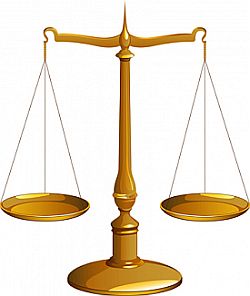
En bra analogi till en ekvation är en balansvåg.

En ekvation betyder en likhet och det är analogt med att vågen är balanserad så att den väger jämnt dvs så att det är lika mycket i de båda vågskålarna. Denna jämvikt kan bibehålles om man lägger på lika mycket i vänster som i höger vågskål. eller drar ifrån lika mycket i båda vågskålarna.

Faktum är att det är tillåtet att göra vad som helst i ekvationens ena led om man gör samma sak i det andra. Detta utnyttjar man vid ekvationslösning.


Exempel:

x + 2 = 5

Att lösa en ekvation innebär att man får x ensamt på ena sidan av likhetstecknet. 

Det kan vi här få genom att man subtraherar med två på båda sidor om likhetstecknet.

x + 2 – 2 = 5 – 2

x = 3.

Man kan alltid kontrollera att ekvationen är korrekt löst genom att  pröva lösningen dvs

man ersätter lösningen med det funna x-värdet.

Om lösningen är korrekt så blir då vänsterledet = högerledet.

Ett sätt att lösa ekvationer med nämnare är att förlänga båda leden med den minsta gemensamma nämnaren. Detta resulterar i att x avlägsnas från nämnaren och hamnar i täljaren istället. .

50/(3x) = 2/9


Mgn 9x

9x (50/(3x)) = 9x(2/9)

150 = 2x

x = 75


Olikheter hanteras på samma sätt som ekvationer. Den enda skillnaden är att man måste vända på olikhetstecknet om man förlänger eller förkortar med ett negativt tal.

Publicerat i Gymnasiematematik(high school math), matematik 1c | Märkt , , | Lämna en kommentar

Reflection 2:

Is it posible to reduce the number of coordinates necessary to specify the position in space from three to one if space itself is quantised?

Publicerat i Uncategorized | Lämna en kommentar

A reflection

Is faculty defined for non-integers?

Ex 5! =5*4*3*2*1=120
What about 0.1!?

Publicerat i Uncategorized | Lämna en kommentar

Complex integral solved with Cauchy’s integral formula

Arfken 6.4.4Arfken 6.4.4

Publicerat i Calculus, Imaginary numbers, Uncategorized | Märkt , | Lämna en kommentar

Partial differential equations

A Partial differential equation is a differential equation that contains unknown multivariable functions and their partial derivatives. They are used to formulate problems involving functions of several variables. They can either be solved by hand or used to create a relevant computer módel.

Almost all the elementary and numerous advanced parts of theoretical physics are formulated in terms of differential equations. Often partial differential equations.

The most frequently encountered are:

              1. Laplace’s equation: 2   ψ = 0. Important in the study of electromagnetic phenomena, dielectrics, steady currents and magnetostatics, hydrodynamics (irrotational flow of a perfect fluid, and surface waves, heat flow, gravitation.)
              2. Poisson’s equation:∇2   ψ = ρ/ε. Non-homogenous with a source term.
              3. The Helmholtz equation or wave equation: 

2   ψ+ k2ψ = 0 and time-independent diffusion equations. This equation can be used to describe : elastic waves in solids, bars, membranes, sound, acoustic waves, nuclear reactors

              1. The time dependent diffusion equation: ψ= δψ/δta-2 . 
              2. The time-dependent wave-equation □2ψ =0.
              3. The scalar potential equation. □2ψ = -ρ/ε.
              4. The Klein-Gordon equation □2ψ =μψ 
              5. The Schrödinger equation

-h2/(2m)∇ψ + V ψ = Eψ describing the motion of the sub-atomic particles.

            1. Maxwell’s coupled differential equationsfor electric and magnetic field and Dirac’s equation for the relativistic electron wave
            2. function.
            3. Differential form
              Name ”Microscopic” equations ”Macroscopic” equations
              Gauss’s law \nabla \cdot \mathbf{E} = \frac {\rho} {\varepsilon_0} \nabla \cdot \mathbf{D} = \rho_f
              Gauss’s law for magnetism \nabla \cdot \mathbf{B} = 0
              Maxwell–Faraday equation
              (Faraday’s law of induction)
              \nabla \times \mathbf{E} = -\frac{\partial \mathbf{B}} {\partial t}
              Ampère’s circuital law
              (with Maxwell’s correction)
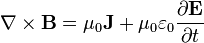
              \nabla \times \mathbf{B} = \mu_0\mathbf{J} + \mu_0 \varepsilon_0 \frac{\partial \mathbf{E}} {\partial t}\ \nabla \times \mathbf{H} = \mathbf{J}_f + \frac{\partial \mathbf{D}} {\partial t}
Publicerat i Calculus, Gymnasiematematik(high school math), matematik 4 | Märkt , , , , , , , , , , , , | 1 kommentar

Differential equations of the second order

Second order differential equations of the homogen type

y” (x)+ a y'(x) + by(x) = 0

are possible to solve with the aid of the characteristic equation

r2 + a r +b =0

If this have the roots r1 and r2  

the solution is given by

y(x) = Cer1x + Der2 x  

If the equation is inhomogenous and the right side is a polynom assume a solution a polynomial of the same degree

If the right side is a trigonometric function assume a as a solution a combination of trigonometric functions.

Ex. Solve the equation y” -3y – 4y = 0

Solve the characteristic equation: r2-3r-4 = 0
r=4 och r = -1.

The general solution is y = Ce-4x + Dex
Where C and D are arbetare constants.

Publicerat i Calculus, matematik 4, matematik 5 | Märkt | 2 kommentarer

Similarity

Two triangles are similar if all the corresponding angles are equal.

Then the ratios of the corresponding sides to each other are the same for both triangles.

In the fig above AB/BC = DE/EF or AB/DE = BC/EF.

A list of all the cases of similarity:

Fractals are made up of similar geomtetrical objects.

See e.g. the Serpinski triangle.

Fracrtals can be used to describe objects encounterd in real life such as coastlines, trees or clouds.

Publicerat i Geometri, Gymnasiematematik(high school math), matematik 2c | Märkt , , , | Lämna en kommentar

How to draw exceldiagrams

My instruction video concerning drawing diagrams in Excel:

http://www.youtube.com/watch?v=NSO04ELH4Qg

Publicerat i Uncategorized | Lämna en kommentar