
Differential equations of the form
dy/dx = – P(x)/Q(y)
then it is possible to separate the variables
Q(y)dy = – P(x) dx → Q(y) dy + P(x) dx = 0
Ex
y´+ sinx y = 0
y´ = -sinx y
dy/y = -sinx dx
Integrating both sides
lny = cosx +C
y = Decosx
Differential equations of the form
dy/dx = – P(x)/Q(y)
then it is possible to separate the variables
Q(y)dy = – P(x) dx → Q(y) dy + P(x) dx = 0
Ex
y´+ sinx y = 0
y´ = -sinx y
dy/y = -sinx dx
Integrating both sides
lny = cosx +C
y = Decosx
Cylindrical coordinates can be considered as a hybrid between spherical coordinates and rectangular coordinates.
The coordinates of a point is given by the angle between the projection of the point in the xy-plame Φ and two distances: the distance from the point to the xy-plane (z) and the distance to the z-axis (ρ).


Polar coordinates
The number of figures necessary for specifying the position of a point is called the dimension of the space.
For a two dimensional space it is sufficient to use two numbers (x, y) : one specifying the position on a right ot left scale and the other number giving the position on the up- and down scale. (x,y) are often referred to as the cartesian coordinates of a point.
Alternatively one can use polar coordinates where one uses the angle between an arrow pointing at the point and the length of the arrow (r, φ).
These are related by x=r cos(φ) and y =rsin(φ)
In three-dimensional space, our world for example, consequently three numbers are necessary. (x, y, z)
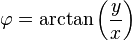
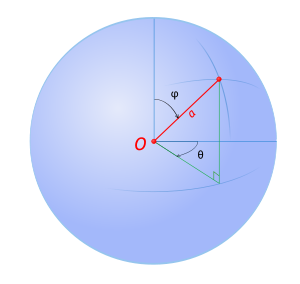
An alternative is the spherical-polar coordinates involving the radius, the azimuthal angle (φ) and the the declination (θ).
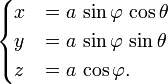
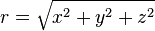 (Pythagorean theorem in three dimensions)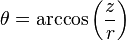
Perhaps after 53 lectures it’s about time that I define what I mean with mathematics?
Mathematics can be defined as the science dealing with quantities, numbers and geometrical objects in particular.
It is characterised by its logical method which consists of drawing logical conclusions from already proven results. This chain of reasoning can then be traced all the way back to the fundamental axioms.
Kant pointed out that mathematics is a purely theoretical science.
The axiomatic system of mathematics is independent of the physical world. Still mathematics is of outmost importance for the empirical sciences since it provides a means for constructing mathematical models able to accurately describe and predict outcomes in the real world.


First chinese carrier commissioned on sep. 26th.
Factorization means to decompose a number or polynomial into a product of other objects, called factors, which when multiplied together gives the original number or polynomial.
Ex. The number 16 = 2*2*2*2 when factorized into prime numbers. Since prime-numbers can’t be factorized it is the final stage of factorization of numbers.
Also polynomials can be factorized with e.g. the conjugate rule
x4 -1 = (x2-1)(x2+1) = (x-1)(x+1)(x2+1)
or with the theorem of factorization stating that the roots of a polynomial are also factors of that polynomial.
Ex.
Consider the polynomial p(x) = (x-2)(x-3).
As can easily be seen the roots of p(x) are x = 2 and x = 3.
Multiplying the parentheses results in
p(x) = x2 – 5x + 6.
Therefore
x2 – 5x + 6 = (x-2)(x-3)
Therefore the roots to this polynomial are also the factors of it!
Numerology is an old phenomenon in many cultures. It is represented both in art an buildings. Buildings are constructed according tothe Golden Section and magical quadrats can be found in eg Albrect Durer’s painting ”Melancholy”.
A substantial amount of mathematics is hidden in Pascal’s triangle. This triangle isbased on the principle that an element in it is the sum of the nearest elements above it.

The elements in Pascal’s triangle turns out to be the binomial-coefficients. This means that they are identical to the numbers you get when you expand binomials with different exponentials. A binomial is the sum of two numbers (x + y) .
As an example we can take (x+y)^2 = x^2 + 2xy + y^2.
The coefficients here can be found in the second row of the periodic system: 1 2 1.
The coefficients for (x + y) ^3 is given by the third row: 1 3 3 1 and so on.
This is spectacular in its own right but it doesn’t end there: The binomialcoefficients also have a combinatorical interpretation: They give the number of combinations if you e.g. are to select k objects out of n possible.
Example: Suppose you wish to pick 2 apples out of a set of three. You find the answer as the second element in the third row: 3.
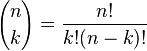
This is called the number of combinations possible when selecting two elements from a set of three. In a combination the order is irrelevant. According to convention it is writen as
 Theorem
Suppose U is an open subset of the complex plane C, f : U → C is a holomorphic function and the closed disk D = { z : | z − z0| ≤ r} is completely contained in U. Let  be the circle forming the boundary of D. Then for every a in the interior of D:

where the contour integral is taken counter-clockwise.
The proof of this statement uses the Cauchy integral theorem and similarly only requires f to be complex differentiable. Since the reciprocal of the denominator of the integrand in Cauchy’s integral formula can be expanded as a power series in the variable (a − z0), it follows that holomorphic functions are analytic. In particular f is actually infinitely differentiable, with

This formula is sometimes referred to as Cauchy’s differentiation formula.
The circle γ can be replaced by any closed rectifiable curve in U which has winding number one about a. Moreover, as for the Cauchy integral theorem, it is sufficient to require that f be holomorphic in the open region enclosed by the path and continuous on its closure.
This proof is based on the fact that the value of the integral is invariant under deformation as long as the integrand is analytic over this closed area.
Cauchy‘s integral theorem states that an analytic function f(z) the line integral around a closed path C is zero.
∫f(z)dz = 0 .
This means that the curve integrals over 2 curves with the same endpoints for an analytic function are the same.

Save the Tiger!

 Miniräknare/calculator
 Kristians Kunskapsbank

